Founded by Wesley O’Brien, a venerable cannabis connoisseur, StrongestMarijuanaStrain.com is more than just a blog; it’s a mission to explore and share the most extraordinary marijuana strains known to humanity.

Wesley’s passion for cannabis began over a decade ago, leading him through countless cultivations, dispensaries, and hidden gems worldwide. This blog is his personal canvas, painted with the stories, strains, and experiences gathered along the way.
The Mission of this Site To enlighten, educate, and share the unparalleled joy and complexities of cannabis. We aim to break stereotypes, introduce you to new horizons of cannabis strains, and foster a community where everyone from novices to experts can find value and camaraderie.
Our Values
- Passion for Cannabis: Our love for cannabis drives everything we do. We’re not just about the strongest strains but the stories, science, and culture behind them.
- Authenticity: Every post and recommendation comes from genuine experience and a place of honesty.
- Community: We believe in building connections, sharing knowledge, and growing together.
What sets us apart is not just our pursuit of the world’s strongest strains but our commitment to sharing this journey with you, our readers. Join us as we continue to explore the depths of cannabis culture and innovation.
- Marijuana vs. CBD: A 70s Kid’s Guide to What’s What
Synopsis
If you grew up in the 1970s, the word marijuana probably brings back a very specific picture: tie-dye shirts, basement stereos, and that unmistakable skunky smell drifting out of a concert parking lot. Back then nobody talked about CBD, hemp extract, or cannabinoids—we just knew weed either got you high or it didn’t. Today the shelves are full of CBD oils, gummies, and creams that promise relaxation without the head buzz, and it can feel confusing. This article explains, in everyday language, the real difference between marijuana and CBD: where they come from, what they do in the body, why one gets you stoned and the other doesn’t, and how the laws and attitudes have changed since the days of bell-bottoms and lava lamps.
I’m a child of the 70s. I remember when “pot” was something you either smoked behind the garage or pretended you didn’t know anything about. There were no fancy dispensaries, no lab reports, and definitely no CBD gummies next to the vitamins at the health store. You had two categories: the stuff that got you high and the stuff that was probably oregano your cousin sold you.
Fast-forward fifty years and the cannabis world looks like a whole different planet. Now people talk about CBD for sore knees, sleep, and anxiety, and half the folks using it have never touched a joint in their life. So what changed? And what’s the real difference between marijuana and CBD?
Let’s break it down the way we would’ve talked about it on a shag carpet with a Lynyrd Skynyrd album spinning in the background.
1. Back to Basics: It’s All the Same Plant—Sort Of
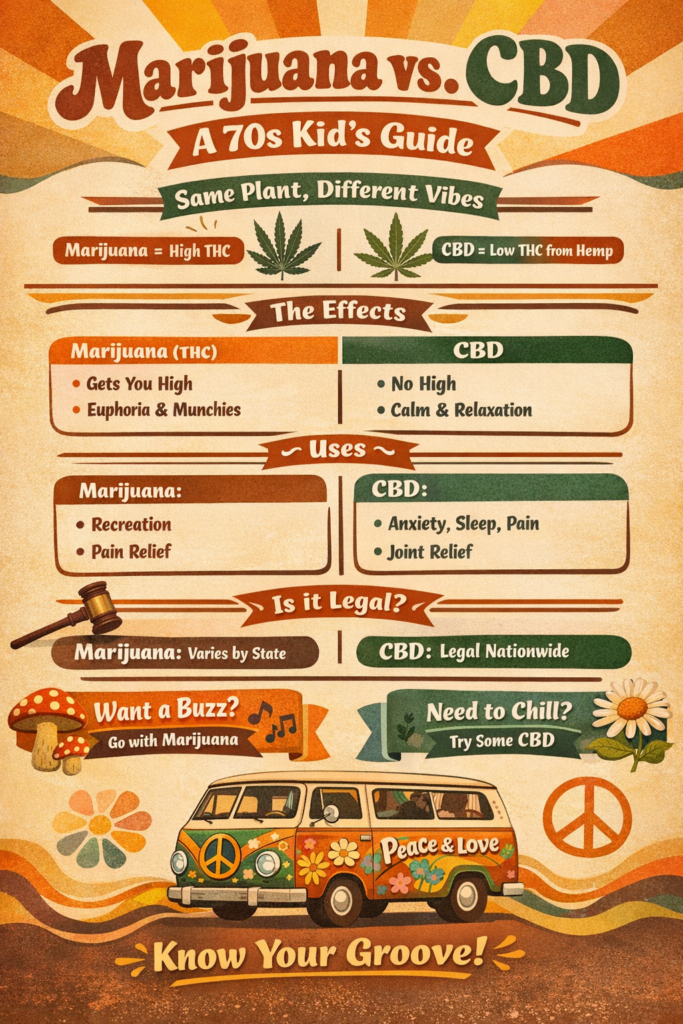
Marijuana and CBD both come from the cannabis plant family. Think of it like tomatoes. You’ve got beefsteak, cherry, and heirloom—same family, different personalities.
- Marijuana is cannabis bred to be high in THC (tetrahydrocannabinol), the compound that makes you feel high, goofy, hungry, or like you suddenly understand the universe.
- CBD (cannabidiol) usually comes from hemp, a cousin of marijuana that’s naturally low in THC.
So the big difference isn’t the plant itself—it’s what the plant is rich in.
Back in the 70s nobody used the word “THC.” We just said, “This is good stuff” or “This is weak.” Today the scientists can tell you the exact percentage like it’s motor oil.
2. The High vs. The No-High
Here’s the simplest way to remember it:
- Marijuana = THC = gets you high
- CBD = not intoxicating
CBD doesn’t make you see pink elephants or raid the fridge at midnight. Most people describe it as subtle—like taking the edge off without messing with your head.
A lot of my friends from the old days tried CBD expecting the same feeling they got from a joint in 1978. Then they’d say, “I don’t feel anything!” That’s the point. CBD is more like a cup of chamomile tea than a shot of tequila.
3. What Each One Is Used For
Marijuana (THC-dominant)
Folks use marijuana for:
- Relaxation and euphoria
- Creativity and music appreciation
- Appetite stimulation
- Pain relief
- Just plain having a good time
It’s recreational for some, medical for others. But it definitely changes how your brain works for a few hours.
CBD
CBD is more of a wellness tool:
- Sore backs and cranky joints
- Sleep support
- Stress and nervous tension
- Skin issues when used as a cream
- General “take the edge off” feeling
Think of marijuana as the loud rock concert and CBD as the acoustic set on the back porch.
4. Why They Affect Us Differently
Inside your body is something scientists call the endocannabinoid system. In the 70s we didn’t know we even had one—turns out we were built with little receptors that interact with cannabis compounds.
- THC plugs directly into those receptors and flips the “altered state” switch.
- CBD works more like a moderator. It nudges the system without slamming the gas pedal.
That’s why THC can make you feel spacey while CBD usually just feels calming.
5. The Legal Rollercoaster
If you lived through the Nixon era, you remember how marijuana was treated like public enemy number one. Cops, commercials, “Reefer Madness” vibes—the whole deal.
CBD took a different road:
- The 2018 Farm Bill made hemp-derived CBD legal at the federal level as long as it contains less than 0.3% THC.
- Marijuana is still a patchwork—legal in some states, illegal in others, and federally complicated.
So today you can buy CBD at the mall, but marijuana might still require a dispensary card depending on where you live. Imagine telling your 1975 self that one day grandma would be ordering hemp lotion online.
6. Forms: Not Just a Rolled Joint Anymore
Back then your choices were simple: joint, pipe, maybe a brownie if someone’s hippie aunt was feeling ambitious.
Now look at the menu:
Marijuana comes as:
- Flower
- Vape carts
- Edibles
- Drinks
- Concentrates
CBD shows up as:
- Oils and tinctures
- Gummies
- Topical creams
- Capsules
- Pet treats (yes, even the dog is in on it)
It’s less Cheech & Chong and more Whole Foods aisle seven.
7. Will CBD Show Up on a Drug Test?
This is the question every working stiff asks.
- Pure CBD shouldn’t cause a positive test.
- But full-spectrum products can have tiny traces of THC.
- If your job tests, you want THC-free or isolate CBD.
In the 70s nobody worried about drug tests at the factory—different times.
8. Side Effects: Old School vs. New School
Marijuana can bring:
- Red eyes
- Short-term memory lapses
- The munchies
- Occasional paranoia
CBD is usually milder:
- Maybe a little drowsy
- Dry mouth
- Generally well tolerated
That’s why so many folks who swore off weed years ago are perfectly comfortable with CBD.
9. Why So Many Boomers Are Coming Back
I’ve watched a funny full circle happen. The same generation that got scared away from pot is now using CBD for:
- Achy knees from years on the job
- Trouble sleeping
- Stress from watching the news
- Arthritis in hands that once rolled perfect joints
They don’t want to be stoned—they just want to feel like their 40-year-old self again.
10. Choosing Between the Two
Ask yourself:
- Do I want a buzz? → That’s marijuana/THC.
- Do I want relief without feeling high? → That’s CBD.
- Do I live somewhere marijuana is legal?
- Do I need to pass a drug test?
There’s no right answer, just the right tool for the job.
Final Thoughts from an Old 70s Soul
Marijuana and CBD are like two siblings who took different paths. One became the wild musician who still tours with a van full of amps. The other became the mellow yoga teacher who brings soup when you’re sick.
Neither is the devil they warned us about on those scratchy filmstrips in high school. But they aren’t the same thing either.
If you’re confused, don’t feel bad. Most of us who lived through disco and Watergate are still catching up. The important part is knowing the difference so you can choose what fits your life today—not the rumors we heard behind the bleachers in 1976.
Peace, love, and read the label.
- How to Grow a Non-Hemp Garden in an Urban Setting

Gardens provide the ideal setting to grow the plants you love, enjoy nature and reap its many rewards. While traditional backyard gardens may not be feasible in an urban environment, you can still cultivate an urban garden that’s full of beauty and fresh vegetables – here are a few ways that it could work:
If you want an easy way to create an urban garden, containers or hanging baskets may be your solution. Perfect for small patios, balconies and apartment garden spaces where space is at a premium, almost any container should work, just make sure it allows enough room for the plant’s roots. Also ensure it drains well – and use potting soil instead of garden soil as this lighter formula has been sterilized to remove any potential weeds or diseases which might harm your vegetables!
Remember to grow hemp away from prying eyes
Vertical gardens can also provide another option. Cucumbers are one of the classic plants for vertical gardening in urban gardens; when planted they start out looking like normal vines but soon after being placed they begin unfurling their “tentacles” to attach themselves to nearby supports such as fences, wooden benches, wire rods fishing line trellises trellises or metal railings – even stems of nearby plants! You can train cucumbers to climb walls fences structures in your urban garden or create one yourself using bamboo poles fishing line trellises trellises or wood lattice.
As urban gardens tend to be smaller spaces, it’s crucial that plants chosen are timeless in appearance year-round. This means choosing flowers with beautiful foliage, an extended blooming period and interesting forms or shapes. Also consider picking pollinator-attracting varieties like zinnias or black-eyed susans that draw pollinators closer.
If you have the space, consider creating a shade garden. Although urban gardens often face challenges in creating this kind of environment, it is possible to achieve spectacular results with careful design. Consider planting bamboo hedge (Phyllostachys aureosulcata) or tree fern (Dicksonia antarctica) as either screening plants or ground covers – both are easy care plants that look wonderful when placed under cover.
Many cities feature community gardens managed by local people to provide green spaces. If you aren’t ready to commit to your own urban garden yet, why not join an existing one instead and help maintain it alongside fellow city-dwellers?
Start planning an urban garden today by collecting essential gardening supplies – pots, trowel, hand pruners, gardening gloves and watering can are among the must-haves! Additionally, keeping an extra storage tote nearby could keep all your tools organized when not being used – Extra Space Storage facilities offer storage solutions nationwide so that your urban garden project stays on track!
- The Effects of Choosing the Right Marijuana Strain
When it comes to marijuana, your selection of strain is key to your overall experience. Each variety contains various concentrations of cannabinoids – specifically tetrahydrocannabinol (THC) and cannabidiol (CBD), plus additional compounds which influence smell, taste, and effects. Cultivators and farmers have long used breeding practices to breed specific characteristics into hybrid or purebred strains for specific effects; using combinations of cannabinoids and terpenes you can customize effects that meet both medical needs or personal desires.
Different cannabis strains offer unique effects to help you feel calm, relaxed, and content. These effects depend on a balance between cannabinoid content and its terpene profile; high concentrations of THC for an intoxicating psychoactive high are popular while those seeking pain or anxiety relief often prefer CBD-rich strains with a high CBD level instead. A balanced THC/CBD strain, commonly referred to as “type II” or 1:1 strain offers mild euphoria alongside relief from symptoms.
Commonly, cannabis strains are classified into three broad categories based on their effects: indicas, sativas and hybrids. Unfortunately, this categorization doesn’t always accurately represent each strain’s unique cannabinoid profile and terpene profile; Indica strains tend to produce relaxing or sedating effects while Sativa varieties provide energetic upbeat ones; hybrid strains often provide both indica and Sativa effects depending on genetic makeup;
Indica strains such as OG Shark, Afghani and Purple Kush are popular options for those seeking relaxation and an inner calm; on the other hand, Jack Herer and Tangerine Dream sativas are known for their stimulating effects.
Many strains are designed to address specific conditions, like anxiety, insomnia and appetite stimulation. GSC (commonly known as Girl Scout Cookies) is one of the most widely used indica strains for stress and anxiety relief as well as relieving muscle tension and relieving pain. Sativa strains like Maui Wowie and GDP provide stimulating stimulation which is ideal for improving creativity while alleviating fatigue.
Locating the ideal marijuana strain can be challenging due to differences in body chemistry. To find your ideal strain, experiment with various options and record which ones you enjoy the most. It may also be beneficial to consult a medical marijuana dispensary or doctor for professional guidance and advice.
- Choosing the Right Cannabis Strain
Cannabis strains are classified by their cannabinoid and terpene profiles, which have an impact on how they make you feel. These effects depend on both genetic makeup and crossbreeding processes within each strain; each unique strain offers unique results; some strains provide relaxing effects, while others give an energetic boost or mood lift. The best way to determine which strain best meets your needs is to try multiple variants and compare results between indica, sativa and hybrid varieties – perhaps starting by researching these differences first!
Cannabis plants have been selectively crossbred for thousands of years, leading to their classification into indica, sativa, and hybrid varieties. Each variety boasts its own individual chemical profile which ultimately contributes to different concentrations of THC (the psychoactive compound found in marijuana) as well as CBD, an non-psychoactive cannabinoid that offers multiple medical benefits.
THC-dominant strains, with high THC concentration and minimal CBD levels, provide a more intense euphoric experience and are frequently chosen by patients seeking relief for depression, anxiety, pain relief, insomnia or other conditions. Balanced 1:1 THC/CBD strains offer balanced effects with mild euphoria alongside relief from symptoms; such strains are popular choices among new consumers seeking relief for chronic pain relief, fatigue or nausea.
Sativa-dominant strains, with their fruity and citrus flavors, can help you stay focused while simultaneously relieving stress and stimulating appetite stimulation. Some popular varieties of these sativa-dominant strains include Granddaddy Purple – known to relax both body and mind while providing peace with problems – Blue Dream (renowned for relaxing effects) and Sour Diesel (proven to reduce headaches, stress levels, depression levels and increase focus).
Noting the impact of cannabis consumption will depend on many variables, including tolerance, dosage and your mindset/environment when smoking it. Consuming cannabis when feeling stressed out in public could negatively alter your mood; furthermore, certain strains could potentially cause cottonmouth, or dry mouth, symptoms.
Green Point Wellness’s team of budtenders is available to answer any queries about available strains and their unique effects. We can assist in choosing which strain best meets your needs, suggesting delivery systems that produce consistent results, and keeping track of effects to identify which kind of cannabis strain works for you best. Be sure to try several strains and delivery systems, and have patience; finding your ideal marijuana strain could take some time!
- What Are the Effects of a Marijuana Strain?
A marijuana strain is a variety of cannabis that has been carefully selected for its unique aroma, potency, appearance and effects. Strains can generally be divided into three groups: indica, sativa and hybrid. Although indica and sativa types remain widely used by consumers and budtenders to predict which effects a strain might cause them, scientific research indicates that cannabinoid and terpene levels provide more accurate ways of determining its effects.
Indica strains offer heavy sedative effects that are ideal for pain relief and stress management, while Sativa varieties produce an uplifting euphoria to promote creativity and activity. Hybrid strains, on the other hand, offer a balanced high that’s both relaxing and energizing: Lemon Haze has fast-acting THC concentrations which provide energy while alleviating anxiety quickly while strains like Snoop Dogg OG have deeper body relaxation that’s great for pain reduction and managing anxiety effectively.
For an easier, milder experience, try selecting a CBD-dominant strain like Sour Diesel, White Widow or 9-Pound Hammer that contains high levels of CBD but low THC concentration. Such varieties have long been recognized for their therapeutic and medicinal qualities which help relieve stress while alleviating nausea, pain and improving mood.
No matter your need, Golden Goat, Zkittlez and Super Silver Haze all make users feel euphoric and happy; plus these sativa-dominant strains help promote creativity and focus as well as treat stress, depression and fatigue.
Cannabis strains are selectively bred for specific qualities, including increased cannabinoid content, disease resistance and distinct terpene profiles. This breeding approach has resulted in an incredible variety of strains with various effects, making it easy for anyone to find what suits them.
If you’re new to cannabis, use Leafly’s strain lists or consult your budtender for recommendations on the ideal strains for you. Experimenting with different strains is important so that you can identify those with desired terpene and cannabinoid profiles and repeating that experience at home can become simpler.